Mains Answer Writing
 Concept Mapping Mentorship
- Covering Syllabus Through Themes
- GS & Optional




Category: GS-I,
Test Date: 22 Feb 2023 07:00 AM
Evaluated: Yes
Instruction:
- There will be 2 questions carrying 10 marks each. Write your answers in 150 words
- Any page left blank in the answer-book must be crossed out clearly.
- Evaluated Copy will be re-uploaded on the same thread after 2 days of uploading the copy.
- Discussion of the question and one to one answer improvement session of evaluated copies will be conducted through Google Meet with concerned faculty. You will be informed via mail or SMS for the discussion.
Question #1. Briefly describe the process of continental rifting. Where is it occurring today.
Question #2. Discuss what is meant by plate-mantle convection and explain the two of the primary driving force for plate motion
(Examiner will pay special attention to the candidate's grasp of his/her material, its relevance to the subject chosen, and to his/ her ability to think constructively and to present his/her ideas concisely, logically and effectively).
STEPS & INSTRUCTIONS for uploading the answers
Step 1 - The Question for the day is provided below these instructions. It will be available at 7:00 AM.
Step 2 - Uploading of Answers : Write the answer in A4 Sheet leaving proper margins for comments and feedback and upload the PDF in MY ACCOUNT section. Click on the option of SUBMIT COPY to upload the PDF.
Step 3 - Deadline for Uploading Answers: The students shall upload their answers by 7:00 PM in the evening same day. The first 50 copies will be evaluated.
Step 4 - Feedback : Mentors will give their feedback for the answers uploaded. For more personalised feedback, join our telegram channel by clicking on the link https://t.me/mains_answer_writing_cse . A one-to-one session will be conducted with the faculty after copy evaluation in 72 Hrs.
Model Answer
Question #1. Briefly describe the process of continental rifting. Where is it occurring today.
Ans- When Divergent boundaries develop within a continent and also at sea floor. In case of continental divergence landmass may spilt into two or more smaller segments separated by ocean basin. This involves complete process called continental rifting.
Continental rifting begins when plate motions produce opposing (tensional) forces that pull and stretch the lithosphere. Stretching, in turn, thins the lithosphere, which promotes mantle upwelling and broad upwarping of overlying lithosphere. During this process, lithosphere is thinned, while brittle crust rocks break into large blocks. As the tectonic forces continue to pull apart the crust, the broken crustal fragments drop, generating an elongated depression called a continental rift.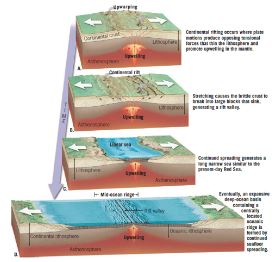
Modern day example of an active continental rift is the east African rift valley. It is an excellent model of initial stage in the break up of continents. Here tensional forces have stretched and thinned lithosphere, allowing molten rock to ascend from the mantle as evident from volcanic activity at Kilimanjaro and Mount Kenya. If rifting continues it will eventually developed as ocean basin. 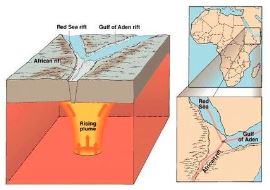
Question #2. Discuss what is meant by plate-mantle convection and explain the two of the primary driving force for plate motion
Ans- Plate -mantle convection is a type of upward movement of less dense material and downward movement of more dense material as a result of subduction of cold, dense slab of oceanic lithosphere. It is a form of heat transfer that involves the actual movement of substance. This involves either a whole mantle convection or part of it.
Two primary driving forces for plate motion as accepted among most of the scholars are:
- Slab Pull
- Ridge push
In case of slab pull cold slabs of oceanic lithosphere are more dense than the underlying warm asthenosphere and hence “ sinks like rock”. In case of ridge push, gravity resulting from the elevated position of oceanic ridge cause slab of the lithosphere to slide down the flanks of the ridge. Ridge push appears to contribute far less to plate motion than slab pull. 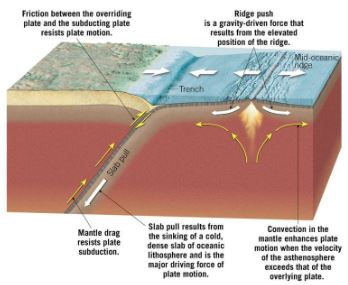
Although the subduction of cold dense lithosphere plate appears to be the dominant force acting on plates, other factors are at work as well. Flow in the mantle known as mantle drag also thought to affect plate motion. If flow in asthenosphere is greater than plate motion it enhance the plate motion, if asthenosphere is moving slower than plate than it resist plate motion. Plate motion is also affected by friction between subducting plate and overriding plate which cause earthquakes.



 Courses
 Study
Notes
Study
Notes Home
Home Resources
 More
More