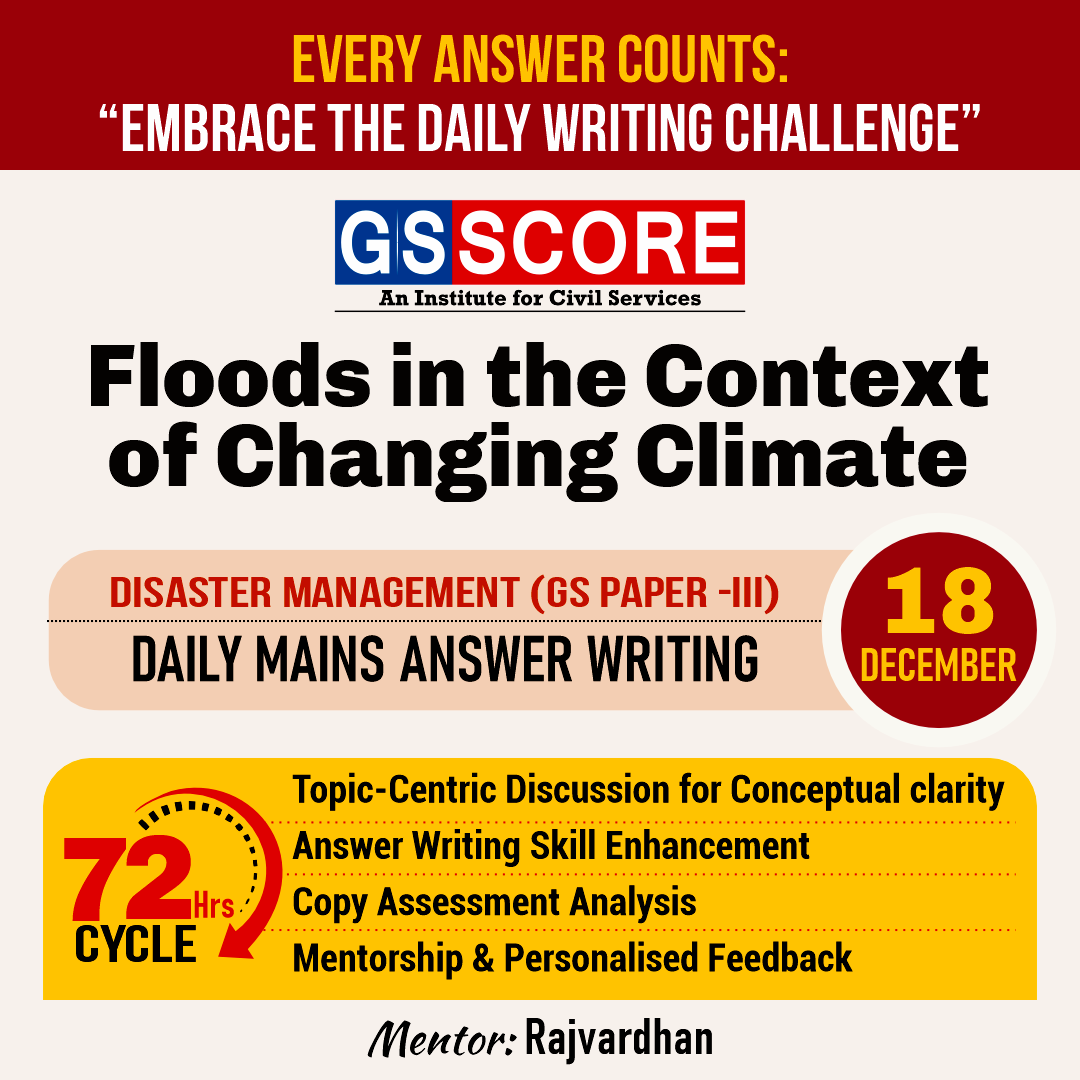
Mains Answer Writing
 Concept Mapping Mentorship
- Covering Syllabus Through Themes
- GS & Optional



Category: GS -III,
Test Date: 18 Dec 2023 07:00 AM
Evaluated: Yes
Instruction:
- There will be 2 questions carrying the First Question is-10 marks Write your answers in 150 words and the Second Question is-15 marks Write your answers in 250 words.
- Any page left blank in the answer-book must be crossed out clearly.
- Evaluated Copy will be re-uploaded on the same thread after 2 days of uploading the copy.
- Discussion of the question and one to one answer improvement session of evaluated copies will be conducted through Google Meet with concerned faculty. You will be informed via mail or SMS for the discussion.
Question #1. What are Glacial Lake Outburst Floods (GLOFs)? What are the causes and impacts of GLOF? Give recent examples. 10 marks (150 words)
Question #2. Why Indian cities are getting prone to urban flooding? What are the causes of urban floods? Suggest mitigation strategies. 15 marks (250 words)
(Examiner will pay special attention to the candidate's grasp of his/her material, its relevance to the subject chosen, and to his/ her ability to think constructively and to present his/her ideas concisely, logically and effectively).
STEPS & INSTRUCTIONS for uploading the answers
Step 1 - The Question for the day is provided below these instructions. It will be available at 7:00 AM.
Step 2 - Uploading of Answers : Write the answer in A4 Sheet leaving proper margins for comments and feedback and upload the PDF in MY ACCOUNT section. Click on the option of SUBMIT COPY to upload the PDF.
Step 3 - Deadline for Uploading Answers: The students shall upload their answers by 7:00 PM in the evening same day. The first 50 copies will be evaluated.
Step 4 - Feedback : Mentors will give their feedback for the answers uploaded. For more personalised feedback, join our telegram channel by clicking on the link https://t.me/mains_answer_writing_cse . A one-to-one session will be conducted with the faculty after copy evaluation in 72 Hrs.
Model Answer
Question #1. What are Glacial Lake Outburst Floods (GLOFs)? What are the causes and impacts of GLOF? Give recent examples. 10 marks (150 words)
Ans
The lakes formed due to the steadily melting ice at the very top of glaciers is what is called a glacial lake. This glacial lake is contained and regulated by dams. However, in the event of a sudden melting or faster than usual melting, as we are seeing in most cases currently due to climate change and global warming then this steady release of meltwater can sufficiently increase either due to excessive rainfall events or a combination of both natural and global warming aggravated reasons. The large release of water at any time from glacial bodies make these lakes very unstable, leading to GLOF.
Causes of GLOF:
1 Extreme Weather Events: Excessive rainfall, heatwaves that result in rapid snow melting, or other disastrous but natural weather events like earthquakes may also become the reason for a glacial lake outburst that can further lead to flooding.
2 Upstream Flooding: another lake being flooded by any of the reasons above mentioned can lead to a domino effect on other glacial lakes downstream. One moment they can be steady and calm and a few moments later they can also be flooding due to the flow of the water coming from upstream.
3 Slope Failure: Rapid slope movement into the lake which involves that melting ice can accumulate overtime behind dams or any other structure and suddenly be released without any warning. This also leads to GLOFs.
4 Lack of Dams or Degraded Dams
5 Tectonic events
Impacts of GLOF:
1) Mountain communities are vulnerable to flooding and other impacts associated with it.
2) Destruction of infrastructure and developmental progress.
3)Large scale displacement of people and loss of life and property.
4) Excessive siltation of downstream dams.
In the recent years, Chamoli district of Uttarakhand in 2021 and Sikkim in 2023 witnessed GLOF.
GLOFs now present a threat to infrastructure and communities downstream. In the Indus, Ganga, and Brahmaputra basins due to climate change number of glacial lakes is increasing and hence to control GLOF it is important to focus on climate change mitigation.
Question #2. Why Indian cities are getting prone to urban flooding? What are the causes of urban floods? Suggest mitigation strategies. 15 marks (250 words)
Ans
Inundation of densely populated areas due to natural and anthropogenic factors leads to urban foods.
In India, urbanisation is happening at a rapid space and mostly this expansion of cities is in an unplanned manner . For example, there is expansion of cities in floodplains, which makes them more vulnerable to urban floods. Also, there is encroachment in the wetlands which acts as sink for flooded water. Add it to this. The urban heat island effect has led to excessive rainfall in cities. All these factors make Indian cities, more vulnerable to urban floods. For example, the recent floods in Delhi, Chennai and Bangalore.
Causes of urban floods:
Natural causes:
- Higher rainfall
- Storm surges and frequent depressions in open waters
- Depleting groundwater tables
- Heavy melting of snow causes flash floods in lowercatchment areas
Anthropogenic causes:
- Encroachments on drainage areas like lakes, wetlands, and riverbeds close off ways for the excess water to flow thus causing floods.
- Climate change has disrupted the rainfall pattern; also, urban heat lands have increased rainfall over urban areas resulting in flooding.
- Pollution of water bodies is choking up the pathways for excess water to flow. Many of the water bodies in the country are filled with non-biodegradable waste, pointing to the poor implementation of waste management as well.
- Illegal mining activities in rivers deplete the natural bed causing soil erosion and reducing the water retention capacity of the water body.
- Unplanned and uninformed release of water from dams causes devastation as the public does not get enough time to respond.
- The importance of Flood governance is also not taken seriously by the administrators
In order to reduce the impacts of urban floods, following strategies can be suggested:
1) Build away from floodplains and flood-prone areas- this is the best way to ensure less loss of life and property.
2) Protection of wetlands that acts as sink for flooded water.
3) Creation of sponge cities to make cities more permeable to hold and use rainwater.
4) Desiltation of streams in the cities.
5) proper waste management.
6) More awareness and education of residents are needed to make them known of the risks and responsibilities of dwelling in floodprone areas.
The residential and commercial stakeholders can be further motivated to install green infrastructure options like rain gardens, green roofs, and rainwater harvesting systems to address the problem of urban floods.



 Courses
 Study
Notes
Study
Notes Home
Home Resources
 More
More